
Beginning with Value vs Growth Investment Strategy, the narrative unfolds in a compelling and distinctive manner, drawing readers into a story that promises to be both engaging and uniquely memorable.
Understanding the differences between value and growth investment strategies is crucial in navigating the complex world of investments. As we delve into the risk and return characteristics of each approach, we explore real-world examples to illustrate their impact on investment decisions.
Value vs Growth Investment Strategy
Value and growth investment strategies are two popular approaches to investing in the stock market. The key differences between these strategies lie in the types of companies they target and the characteristics they prioritize.
Key Differences
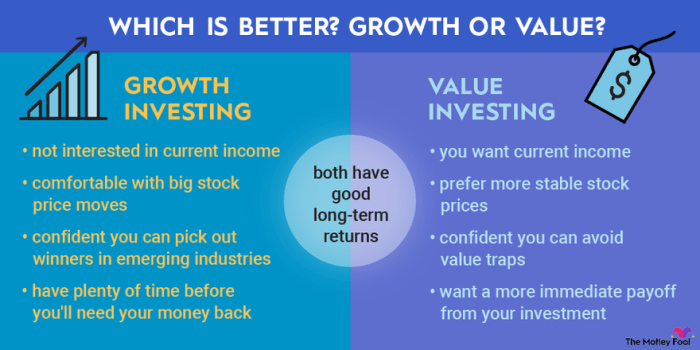
Value investment strategy focuses on finding stocks that are currently undervalued by the market based on metrics like price-to-earnings ratio, price-to-book ratio, and dividend yield. Investors using this strategy believe that the market has underestimated the true value of these companies, and that their stock prices will eventually rise to reflect their intrinsic value.On the other hand, growth investment strategy involves investing in companies that are expected to grow at a faster rate than the overall market.
These companies typically reinvest their earnings into expanding operations, developing new products, or acquiring other businesses to drive future growth. Investors using this strategy are willing to pay a premium for these companies in anticipation of higher future returns.
Risk and Return Characteristics
Value stocks are generally considered to be less risky than growth stocks because they are already trading at a discount to their intrinsic value. However, they may also have lower growth potential compared to growth stocks. Value investors typically seek stable companies with solid fundamentals and consistent cash flows.On the other hand, growth stocks are seen as riskier investments due to their higher valuation multiples and reliance on future growth prospects.
While they have the potential for higher returns, they are also more susceptible to market volatility and economic downturns. Growth investors often target companies in innovative industries with the potential for rapid expansion.
Examples of Companies
Examples of companies that typically fall under the value investment strategy include established blue-chip companies with stable earnings and dividends, such as Johnson & Johnson, Coca-Cola, and Procter & Gamble.On the other hand, companies like Amazon, Tesla, and Netflix are often considered growth stocks due to their high growth potential, disruptive business models, and focus on innovation and expansion.
Investment Advice
When it comes to managing your investments, seeking advice from a professional can make a significant difference in achieving your financial goals. An investment advisor can provide valuable insights, help you navigate the complexities of the market, and tailor strategies to suit your individual needs.
Tips for Selecting an Investment Advisor
- Research and verify the credentials of potential advisors.
- Consider their experience and track record in the industry.
- Look for advisors who align with your investment goals and risk tolerance.
- Check for any conflicts of interest or hidden fees.
Importance of Seeking Professional Investment Advice
Professional investment advice can offer you:
- Access to expert knowledge and insights.
- Customized investment strategies tailored to your financial goals.
- Help in navigating market volatility and making informed decisions.
Common Pitfalls to Avoid When Seeking Investment Advice
- Avoid advisors promising guaranteed returns or unrealistic results.
- Be cautious of advisors pushing high-risk investments without considering your risk tolerance.
- Steer clear of advisors with a history of disciplinary actions or complaints.
- Don’t overlook the importance of clear communication and transparency in your advisor-client relationship.
Investment Banking
Investment banks play a crucial role in financial markets by facilitating the flow of capital between investors and corporations. They provide a wide range of financial services to clients, including corporations, governments, and institutional investors.
Services Offered by Investment Banks
- Underwriting: Investment banks help companies raise capital by underwriting securities such as stocks and bonds. They purchase the securities from the issuer and then sell them to investors.
- Mergers and Acquisitions (M&A): Investment banks advise companies on mergers, acquisitions, and divestitures. They help clients evaluate potential deals, negotiate terms, and facilitate the transaction process.
- Corporate Finance: Investment banks provide strategic financial advice to corporations, helping them optimize their capital structure, manage risks, and achieve their financial objectives.
- Trading and Sales: Investment banks engage in trading activities in financial markets, buying and selling securities on behalf of clients or for their own accounts.
Notable Investment Banking Transactions
-
Goldman Sachs’ role in the initial public offering (IPO) of Alibaba Group in 2014, which raised over $25 billion, making it one of the largest IPOs in history.
-
J.P. Morgan’s involvement in the acquisition of Time Warner by AT&T in 2018, a deal valued at $85 billion that reshaped the media and telecommunications industry.
-
Morgan Stanley’s advisory services to Facebook for its $19 billion acquisition of WhatsApp in 2014, a landmark deal in the tech industry.
Investment Horizon
An investment horizon refers to the length of time an investor expects to hold an investment before selling it. It is a crucial aspect of investing as it helps determine the appropriate investment strategy and risk tolerance for achieving financial goals.
Significance of Investment Horizon
- Longer investment horizons typically allow for more aggressive investment strategies with higher potential returns but also higher risk.
- Shorter investment horizons may require more conservative strategies to protect against market volatility and ensure capital preservation.
- Aligning investment horizon with financial goals ensures that investments have enough time to grow and generate returns to meet specific objectives.
Different Impact of Investment Horizons on Investment Strategies
- For short-term investors, focusing on market timing and short-term price movements is essential.
- Long-term investors can afford to ride out market fluctuations and focus on fundamental analysis and long-term growth potential.
- Mid-term investors may combine elements of both short-term and long-term strategies to achieve a balanced approach.
Tips for Aligning Investment Horizons with Financial Goals
- Clearly define financial goals and establish a realistic investment horizon that aligns with those goals.
- Consider factors such as risk tolerance, liquidity needs, and time horizon when selecting investments.
- Regularly review and adjust investment strategies as financial goals evolve or market conditions change.
Investment Opportunities
Investment opportunities are avenues where investors can potentially earn returns on their capital. These opportunities can arise from various sources such as stocks, bonds, real estate, commodities, and even alternative investments like cryptocurrencies. Evaluating the credibility of investment opportunities is crucial to minimize risks and maximize returns. Here, we will delve into identifying sources of investment opportunities, discussing how to assess their credibility, and sharing examples of successful investment opportunities in different markets.
Identifying Potential Sources of Investment Opportunities
- Stock Market: Companies with strong fundamentals and growth potential.
- Bond Market: Government or corporate bonds with favorable yields.
- Real Estate: Properties in developing areas or with high rental demand.
- Commodities: Precious metals or agricultural products with supply-demand imbalances.
- Alternative Investments: Venture capital, private equity, or cryptocurrencies.
Evaluating the Credibility of Investment Opportunities
- Financial Health: Analyze financial statements, cash flow, and debt levels.
- Market Trends: Consider market conditions, competition, and industry outlook.
- Risk Assessment: Evaluate risks related to the investment, including regulatory, geopolitical, and market risks.
- Expert Opinions: Seek advice from financial advisors, analysts, or investment professionals.
Examples of Successful Investment Opportunities
| Market | Investment Opportunity | Outcome |
|---|---|---|
| Stock Market | Tech Company IPO | Investors gained 100% returns within a year. |
| Real Estate | Commercial Property Purchase | Rental income increased by 20% annually. |
| Commodities | Gold Investment | Investors benefited from the rise in gold prices during economic uncertainty. |
Investment Strategy
Having a well-defined investment strategy is crucial for achieving long-term financial goals and managing risk effectively. It provides a roadmap for making investment decisions, guiding individuals through market fluctuations and economic uncertainty.
The Key Components of a Successful Investment Strategy
- Determine Investment Objectives: Clearly define your financial goals, whether it’s saving for retirement, buying a house, or funding your child’s education.
- Assess Risk Tolerance: Understand how much risk you are willing to take on and align your investments accordingly.
- Asset Allocation: Spread your investments across different asset classes to diversify risk and optimize returns.
- Regular Monitoring and Rebalancing: Stay informed about market trends, review your portfolio periodically, and adjust your investments as needed.
- Long-Term Perspective: Focus on the big picture and avoid making impulsive decisions based on short-term market fluctuations.
Tips for Developing a Personalized Investment Strategy
- Evaluate Your Financial Situation: Take stock of your income, expenses, debts, and savings to determine your investment capacity.
- Define Your Time Horizon: Consider your investment timeline and when you will need to access the funds to tailor your strategy accordingly.
- Consult with a Financial Advisor: Seek professional guidance to create a customized investment plan that aligns with your goals and risk tolerance.
- Stay Informed and Educated: Keep yourself updated on market developments, investment trends, and financial news to make informed decisions.
- Review and Adjust Regularly: Monitor the performance of your investments, track progress towards your goals, and make adjustments as necessary to stay on course.
In conclusion, the debate between value and growth investment strategies offers a nuanced perspective on investment decisions. By grasping the key concepts and examples provided, investors can make informed choices that align with their financial goals and risk tolerance.
Top FAQs
What are the main differences between value and growth investment strategies?
Value investing focuses on undervalued companies with stable earnings, while growth investing targets companies with high growth potential and strong momentum.
How do I select an investment advisor?
When choosing an investment advisor, look for experience, qualifications, and a track record of successful client relationships.
Why is it important to have a well-defined investment strategy?
A well-defined investment strategy helps investors stay focused, avoid emotional decisions, and work towards their financial objectives in a disciplined manner.


