Embark on a journey into the world of Dollar-Cost Averaging Investment Strategy, where consistent investments lead to significant returns. Discover how this strategy can benefit your financial future.
Exploring the concept of dollar-cost averaging and its impact in various market conditions, this strategy offers a steady approach to building wealth over time.
Dollar-Cost Averaging Investment Strategy
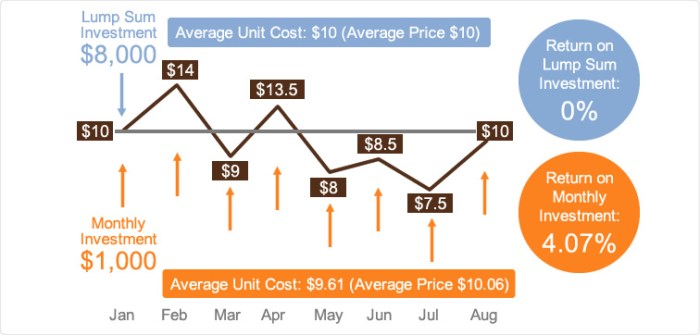
Dollar-cost averaging is an investment strategy where an investor regularly buys a fixed dollar amount of a particular investment regardless of the asset’s price. This approach helps spread out the investment over time, reducing the impact of market volatility.
Examples of Dollar-Cost Averaging in Different Market Conditions
- In a bear market: When prices are falling, purchasing the same dollar amount of shares results in buying more shares at lower prices. This can help lower the average cost per share.
- In a bull market: Buying the same dollar amount of shares when prices are rising may result in purchasing fewer shares. However, by sticking to the strategy, investors avoid trying to time the market and benefit in the long run.
Benefits of Using Dollar-Cost Averaging
- Reduced Risk: By spreading out investments over time, dollar-cost averaging helps reduce the risk of investing a large sum at a potentially unfavorable time.
- Discipline: This strategy encourages disciplined investing by removing the temptation to try and time the market, which can be challenging even for seasoned investors.
- Averaging Out Volatility: By consistently investing a fixed amount, investors can average out the impact of market fluctuations over time, potentially leading to a smoother growth trajectory.
- Potential for Higher Returns: Over the long term, dollar-cost averaging can lead to better returns compared to trying to time the market, as it ensures consistent investments regardless of short-term market movements.
Investment Advice
When it comes to investing, sound investment advice plays a crucial role in helping individuals make informed decisions to grow their wealth over time.
Importance of Seeking Professional Investment Advice
Seeking professional investment advice from a financial advisor or planner is essential for individuals looking to navigate the complex world of investing. These professionals have the expertise and knowledge to assist in creating a customized investment strategy tailored to individual financial goals and risk tolerance levels.
Role of Risk Tolerance in Determining Suitable Investment Advice
Understanding one’s risk tolerance is a key factor in determining suitable investment advice. Risk tolerance refers to an individual’s willingness and ability to withstand fluctuations in the value of their investments. A financial advisor will consider your risk tolerance when recommending investment options to ensure they align with your comfort level and long-term financial objectives.
Investment Advisor
Investment advisors play a crucial role in helping individuals make informed decisions about their financial investments. They provide personalized advice based on the client’s financial goals, risk tolerance, and investment timeline. Here are some key responsibilities of an investment advisor:
Types of Investment Advisors
When it comes to choosing an investment advisor, there are several types to consider, each offering different levels of service:
- Robo-Advisors: These automated platforms use algorithms to create and manage investment portfolios based on client input. They are cost-effective and suitable for those looking for a hands-off approach to investing.
- Financial Planners: These advisors provide comprehensive financial planning services, including retirement planning, tax strategies, and estate planning. They work closely with clients to develop personalized financial plans.
- Wealth Managers: Wealth managers offer a range of services, including investment management, financial planning, estate planning, and tax optimization. They cater to high-net-worth individuals and provide a holistic approach to managing wealth.
Choosing a Reputable Investment Advisor
When selecting an investment advisor, consider the following tips to ensure you work with a reputable professional:
- Qualifications and Credentials: Look for advisors with relevant qualifications such as Certified Financial Planner (CFP) or Chartered Financial Analyst (CFA) designations.
- Fee Structure: Understand how the advisor is compensated, whether through fees, commissions, or a combination of both. Make sure the fee structure aligns with your investment goals.
- Track Record: Research the advisor’s track record and client reviews to gauge their performance and reputation in the industry.
- Communication Style: Choose an advisor who communicates clearly and regularly updates you on your investments and financial plan.
- Personal Fit: Meet with potential advisors to assess their approach and determine if you feel comfortable entrusting them with your financial future.
Investment Banking
Investment banks play a crucial role in the financial market by facilitating the flow of capital between investors and corporations or governments. They provide a wide range of financial services to help clients raise capital, manage risks, and make strategic investment decisions.
Role of Investment Banks
Investment banks help corporations and governments raise capital by underwriting securities such as stocks and bonds. They also provide advisory services for mergers and acquisitions, as well as strategic financial planning. In addition, they assist clients in managing their investment portfolios and mitigating risks associated with complex financial transactions.
Services Provided by Investment Banks
- Underwriting securities offerings
- Advisory services for mergers and acquisitions
- Financial planning and risk management
- Trading of stocks, bonds, and other financial instruments
- Research and analysis of financial markets
Difference between Investment Banking and Retail Banking
Investment banking focuses on providing specialized financial services to corporations, governments, and institutional investors, while retail banking caters to individual consumers. Investment banks deal with large-scale financial transactions, such as mergers and acquisitions, underwriting securities, and managing investment portfolios, whereas retail banks offer basic banking services like savings accounts, loans, and mortgages to retail customers.
Investment Horizon
An investment horizon refers to the length of time an investor expects to hold an investment before selling it. It is a crucial factor in determining the appropriate investment strategy and assessing the level of risk that can be taken.
Significance of Investment Horizon
The investment horizon plays a vital role in investing as it directly impacts the risk and return profile of an investment. A longer investment horizon typically allows investors to take on more risk, as there is more time to recover from potential losses. On the other hand, a shorter investment horizon may require a more conservative approach to avoid significant losses in a short period.
- Long-Term Horizon: Investors with a long-term horizon, such as retirement savings or education funds for young children, can afford to invest in more volatile assets like stocks. This allows for the potential to earn higher returns over time.
- Short-Term Horizon: For investors with a short-term horizon, such as saving for a down payment on a house or a vacation, it is essential to focus on more stable investments like bonds or cash equivalents to protect capital and ensure liquidity when needed.
It is important to align your investment horizon with your financial goals to ensure that your investments are in line with your objectives.
Investment Opportunities
Investment opportunities come in various forms, ranging from stocks and bonds to real estate and commodities. Diversifying your investment portfolio across different asset classes can help manage risk and maximize returns. Here, we will explore the importance of diversification and strategies for identifying high-potential investment opportunities.
Types of Investment Opportunities
- Stocks: Investing in individual company shares can provide potential for high returns but also carries higher risk.
- Bonds: Fixed income securities offer a more stable investment option with regular interest payments.
- Real Estate: Investing in properties can generate rental income and potential capital appreciation.
- Commodities: Investing in assets like gold, oil, or agricultural products can provide diversification and hedge against inflation.
The Importance of Diversification
Diversification involves spreading your investments across different asset classes to reduce risk. By not putting all your eggs in one basket, you can protect your portfolio from the volatility of any single market or industry.
Don’t put all your eggs in one basket.
Strategies for Identifying High-Potential Investments
- Research: Conduct thorough research on potential investments, including analyzing financial statements, market trends, and company performance.
- Consult with Experts: Seek advice from investment advisors or financial professionals who can provide insights and recommendations based on your financial goals.
- Monitor Market Trends: Stay informed about market trends, economic indicators, and global events that may impact your investments.
- Consider Risk-Reward Ratio: Evaluate the risk-reward ratio of each investment opportunity to ensure it aligns with your risk tolerance and financial objectives.
Investment Strategy
Having a well-defined investment strategy is crucial for achieving financial goals and managing risk effectively. It provides a clear roadmap for making investment decisions and helps investors stay disciplined during market fluctuations.
Value Investing, Growth Investing, and Income Investing
- Value Investing: This strategy involves identifying undervalued stocks or assets that have the potential to increase in value over time. Investors following this approach typically focus on companies with strong fundamentals trading below their intrinsic value.
- Growth Investing: Growth investors seek companies with high growth potential, even if they may be trading at a premium. These investors are willing to pay a higher price for stocks of companies expected to grow at an above-average rate.
- Income Investing: Income investors prioritize generating a steady stream of income from their investments. They often turn to dividend-paying stocks, bonds, or real estate investment trusts (REITs) to create a reliable income stream.
Developing a Personalized Investment Strategy
When developing a personalized investment strategy, it’s essential to consider your financial goals and risk tolerance. Here are some tips to help you create a strategy that aligns with your objectives:
- Assess Your Risk Tolerance: Understand how much risk you are willing to take on and adjust your investment strategy accordingly. Risk tolerance can vary based on factors such as age, financial situation, and investment goals.
- Set Clear Objectives: Define your financial goals, whether they are long-term wealth accumulation, retirement planning, or saving for a specific milestone. Having clear objectives will guide your investment decisions.
- Diversify Your Portfolio: Spread your investments across different asset classes, industries, and geographic regions to reduce risk. Diversification can help cushion your portfolio against market volatility.
- Review and Rebalance Regularly: Monitor your investments periodically and make adjustments as needed to stay on track with your goals. Rebalancing ensures that your portfolio remains aligned with your risk tolerance and objectives.
In conclusion, Dollar-Cost Averaging Investment Strategy is a powerful tool for investors looking to navigate market fluctuations with confidence. By staying committed to regular investments, you can harness the power of this strategy for long-term financial growth.
FAQ Explained
What is Dollar-Cost Averaging?
Dollar-Cost Averaging is an investment strategy where you invest a fixed amount of money at regular intervals, regardless of market conditions.
How does Dollar-Cost Averaging work in different market conditions?
Dollar-Cost Averaging helps mitigate the impact of market volatility by spreading out your investments over time, buying more shares when prices are low and fewer when prices are high.
What are the benefits of using Dollar-Cost Averaging?
Some key benefits include reducing the impact of market fluctuations, instilling discipline in your investment approach, and potentially lowering the average cost per share over time.